Introduction
When buying aluminum windows, many people focus on glass, colors, or prices. However, understanding the aluminum window profile is just as important. Every profile consists of several components that work together to provide strength, insulation, security, and smooth operation.
Whether you are planning a new home, replacing old windows, or sourcing windows for a commercial project, learning these basic terms will help you communicate more effectively with manufacturers and choose the right products.
This guide explains the most common parts of an aluminum window profile in simple language.
What Is an Aluminum Window Profile?
An aluminum window profile refers to the extruded aluminum sections used to build a complete window system. Different profiles form different parts of the window, including the frame, sash, mullion, and transom.
Each profile has a specific function, and together they determine the window’s strength, durability, thermal performance, and appearance.
Main Parts of an Aluminum Window Profile
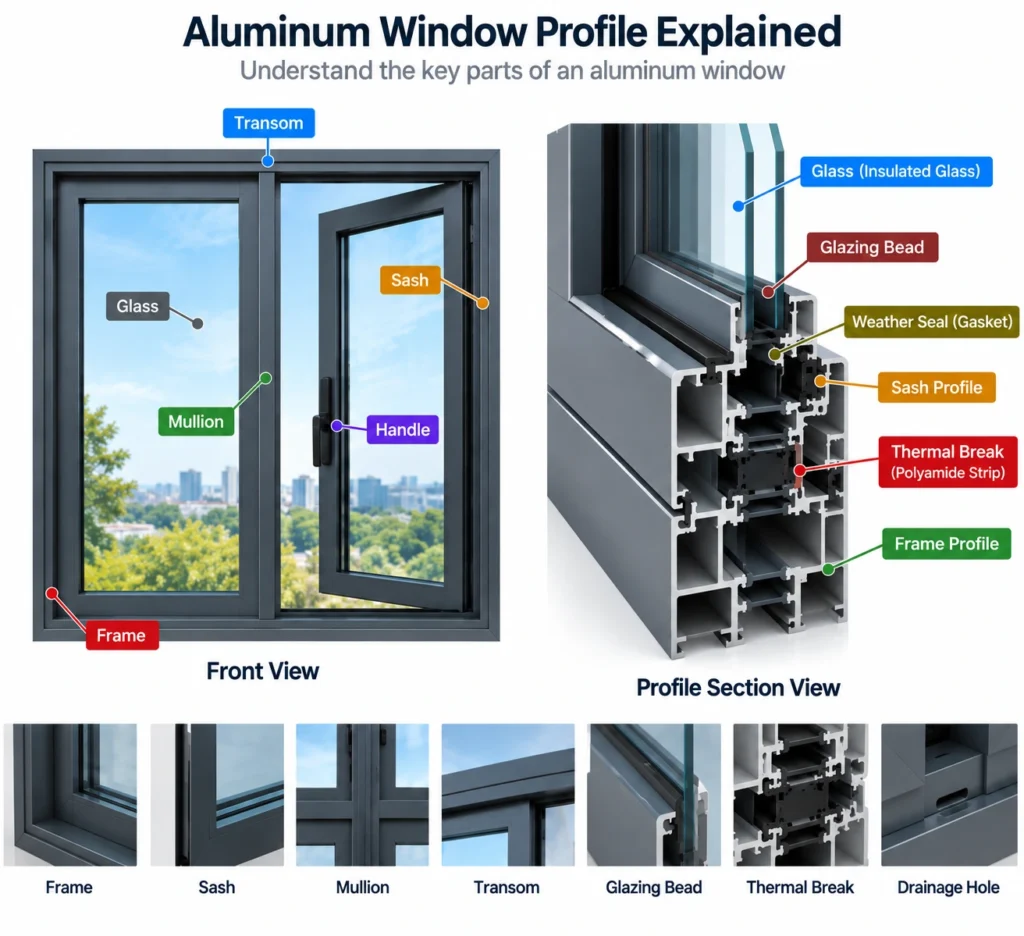
1. Frame
The frame is the fixed outer structure attached to the building wall.
Its functions include:
- Supporting the entire window
- Transferring loads to the building
- Holding the sash securely
- Providing weather resistance
A stronger frame is especially important for large windows and high-rise buildings.
2. Sash
The sash is the movable part that holds the glass.
Depending on the window type, the sash may:
- Swing outward
- Swing inward
- Slide horizontally
- Tilt inward
The sash carries the glass weight, so manufacturers must match it with suitable hardware and profile thickness.
3. Mullion
A mullion is a vertical profile that separates two or more window panels.
Why use mullions?
They help:
- Increase structural strength
- Support larger openings
- Divide multiple window units
- Improve design flexibility
Modern commercial buildings often use reinforced mullions to support large glass panels.
4. Transom
A transom is a horizontal profile installed between window sections.
Unlike a mullion, which runs vertically, a transom runs horizontally.
Transoms help:
- Divide large windows
- Improve structural stability
- Support additional glass panels
- Create decorative window designs
5. Glazing Bead
The glazing bead is a removable profile that secures the glass inside the sash or frame.
Its functions include:
- Holding insulated glass firmly
- Allowing glass replacement
- Supporting weather seals
- Creating a clean interior appearance
Although small, the glazing bead plays an important role in long-term window performance.
6. Thermal Break
A thermal break separates the interior and exterior aluminum sections with an insulating polyamide strip.
Benefits include:
- Lower heat transfer
- Better energy efficiency
- Reduced condensation
- Improved indoor comfort
Thermal break profiles are widely used in energy-efficient residential and commercial buildings.
👉 Learn more in our Thermal Break Aluminum Windows Explained guide.
7. Weather Seals and Gaskets
Rubber gaskets create airtight and watertight seals between the frame and sash.
Good seals help:
- Prevent water leakage
- Reduce air infiltration
- Improve sound insulation
- Increase energy efficiency
Replacing worn gaskets is one of the easiest ways to extend the lifespan of aluminum windows.
8. Drainage System
High-quality aluminum window profiles include hidden drainage channels.
These channels:
- Remove rainwater
- Prevent water accumulation
- Protect internal components
- Improve durability
Proper drainage is essential, especially in regions with heavy rainfall.
How Window Profiles Affect Performance
The design of an aluminum window profile directly influences the window’s performance.
A well-designed profile provides:
- Higher structural strength
- Better thermal insulation
- Improved weather resistance
- Enhanced security
- Longer service life
- Modern aesthetics
That is why manufacturers carefully select different profiles for residential homes, commercial buildings, and high-rise projects.
Residential vs Commercial Profiles
Residential windows usually use slimmer profiles that prioritize appearance and natural light.
Commercial systems often feature:
- Thicker walls
- Reinforced mullions
- Larger thermal breaks
- Heavy-duty hardware
- Higher wind-load resistance
Choosing the correct profile depends on local building codes, window size, and project requirements.
Common Questions
Are thicker aluminum profiles always better?
Not necessarily.
A thicker profile may provide greater strength, but good engineering, quality aluminum alloy, and proper design are equally important. The best profile depends on the window size, glass weight, and local wind conditions.
👉 Learn more in our How to Choose the Right Aluminum Window Frame Thickness guide.
Can window profiles be customized?
Yes.
Many manufacturers offer customized profile dimensions, colors, finishes, and thermal break options to meet different architectural and performance requirements.
Why do modern aluminum windows have so many chambers?
Multiple chambers improve:
- Structural rigidity
- Thermal insulation
- Water drainage
- Hardware installation
- Overall performance
Final Thoughts
Understanding the aluminum window profile helps you make more informed decisions when purchasing windows. Components such as the frame, sash, mullion, transom, glazing bead, and thermal break all contribute to the window’s strength, energy efficiency, durability, and appearance.
At House Essential, we provide factory-direct aluminum window systems designed for residential and commercial projects worldwide. Our experienced team can recommend the most suitable profile configuration based on your climate, building type, and performance requirements.
👉 Contact us today to discuss your project and receive a customized quotation.
How Long Do Aluminum Windows Last? Lifespan, Maintenance & Cost Guide
Best Glass for Aluminum Windows in 2026: Double vs Triple vs Low-E